Catalogue / Guides / Leaflet 10
Full spectrum, broad spectrum, isolate: reading a UK CBD label
Three words on a bottle, none of them defined in law. What they claim, what the 1 mg THC rule asks of the bottle, and how to read the certificate behind them.
Ad This guide links to products sold by UK shops. We earn a commission on sales made through these links.
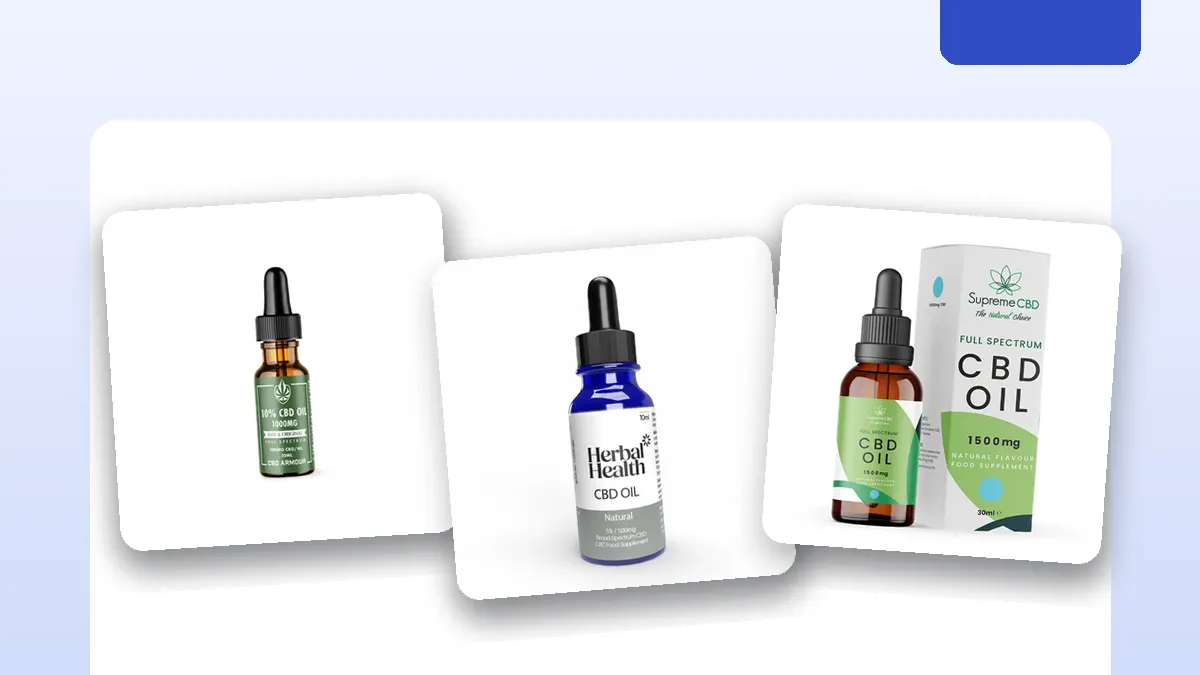
Three words with no legal definition
Full spectrum, broad spectrum and isolate are the three words a CBD label uses to say what kind of extract is in the bottle. They are the maker's words. None of them is defined in the Home Office factsheet, the FSA guidance or the regulations I read for this guide, and the FSA's public list has no field for any of them. What the official texts do use is simpler: they talk about CBD extracts and CBD isolates, and about controlled cannabinoids such as THC.
So a label is a claim by the maker, and the way to read a claim is to find what backs it. Here is how the three words are generally used, and what each one sends you off to check.
| On the label | What makers generally mean | What to check |
|---|---|---|
| Full spectrum | An extract that keeps other compounds from the plant alongside the CBD, which can include a trace of THC. | The certificate: THC and the other controlled cannabinoids, for the whole bottle. |
| Broad spectrum | An extract that keeps some of those other compounds, with the THC taken out or reduced. | The certificate again. "Reduced" is not "none", and the word has no legal definition. |
| Isolate | CBD on its own, a single purified compound. | The purity on the certificate, and the exact name on the FSA list. |
The same goes for the FSA list. Where a spectrum word appears in an entry, the applicant put it there. Supreme's entry for its 1000mg oil, for example, is named as a full spectrum CBD MCT oil in 30 ml, with the mg in the name, and that wording is the maker's description, not a finding by the FSA.
I am a bookkeeper, so my habit is to treat a label like a line on an invoice: it tells you what the seller says, and the paperwork is what tells you whether it holds. In this case the paperwork is a certificate of analysis. Price checked on 19 November 2026 where I give prices.
What the words do not tell you
They do not give the mg. A full spectrum oil and a broad spectrum oil can hold the same 500 mg in 10 ml. They do not give the price: in this catalogue the one broad spectrum oil, Herbal Health's 5%, is £25.99 for 500 mg (5.2p per mg), and a full spectrum oil of the same size and strength, H Drop's, was £13.00 on the shop's page (2.6p per mg). They do not tell you the THC level, which is the figure the law cares about. And they do not tell you the FSA list status: a full spectrum product and a broad spectrum one can both be Validated, or neither.
They also do not tell you that one is better, and this guide will not say so. I have no way to compare the two and no certificate to compare them with. What I can do is show what the words are doing on the shelves in this catalogue, what the law says about THC, and how to read the paper that is supposed to back the word up.
THC: the exempt product rule and the 1 mg limit
Cannabis and cannabinoids such as THC are controlled drugs in the UK. The Home Office factsheet makes two points that matter here. CBD on its own, as an isolated substance in its pure form, is not controlled under the Misuse of Drugs Act 1971. But it is highly likely that CBD products contain controlled Class B cannabinoids such as THC and THC-V, so the product has to pass a separate test.
The test is the exempt product rule in regulation 2 of the Misuse of Drugs Regulations 2001. One of its conditions is that no one component part of the product or preparation contains more than one milligram of the controlled drug. The factsheet says the unit of measure is the container, such as a bottle of oil, and not the dose. It adds that the evidence is an analysis by a laboratory accredited to ISO/IEC 17025, which in the UK means UKAS. The regulation has other conditions, and the application to a given product is a legal question. This is a plain reading of the official texts, not legal advice.
What a limit on the whole bottle means in practice depends on the bottle. A 10 ml bottle can hold 1 mg of THC in total, which is 0.1 mg per ml. A 30 ml bottle can also hold 1 mg in total, which is a third as much per ml. Here is the sum for the oils in this catalogue.
| Bottle | CBD in it | THC allowed per ml if the whole bottle must stay at 1 mg | 1 mg as a share of the CBD |
|---|---|---|---|
| 10 ml | 500 mg | 0.100 mg | 0.20% |
| 10 ml | 1,000 mg | 0.100 mg | 0.10% |
| 30 ml | 1,000 mg | 0.033 mg | 0.10% |
| 30 ml | 1,500 mg | 0.033 mg | 0.07% |
| 10 ml | 3,000 mg | 0.100 mg | 0.03% |
| 30 ml | 3,000 mg | 0.033 mg | 0.03% |
| 30 ml | 6,000 mg | 0.033 mg | 0.02% |
A word on "THC free" and "zero THC", which turn up on some labels and shop pages. I found no definition of either in the official texts. The legal figure is 1 mg per container, not nothing, so a THC free claim and a 1 mg limit are two different numbers. If a page says THC free, look for the report that shows it, and read the reporting limit the same way as in the example below. A claim with no certificate behind it is just a sentence.
Two things follow. The bigger the bottle, the lower the THC concentration has to be to stay under 1 mg. And the more CBD in the bottle, the smaller the share of it that 1 mg represents: 0.2% of the CBD in a 500 mg bottle, 0.02% in a 6,000 mg one. Those shares are my arithmetic. They show why a certificate matters more as the bottles get bigger, not what any particular oil contains. For a pot of gummies or a tub of capsules, what counts as the container is for the maker to show. I have only the factsheet's example of a bottle of oil.
Reading a certificate of analysis
A certificate of analysis, a COA, is the lab's report on one batch. Shops that publish them usually link to the PDF from the product page. Read it in this order.
- The lab. Is it named, and does it say it is accredited to ISO/IEC 17025? The factsheet says that is the standard that counts.
- The batch. Does the batch number match the one on your bottle? A certificate for another batch tells you about that batch.
- The date. A certificate is a snapshot. A report from long before the product was made is a weak document.
- The CBD figure. Convert it to the whole bottle and compare it with the label. A result of 100 mg per ml in a 10 ml bottle is 1,000 mg.
- The THC figure, and the other controlled cannabinoids. This is the line that matters under the 1 mg rule, and it has to be taken for the whole bottle too.
- The reporting limit. Look for "ND" (not detected) or "below LOQ" (limit of quantification). They mean the lab found nothing above its limit, and the limit is on the report.
The last point is where people get caught, so here is an invented example, not a figure from any shop. A report says THC is "not detected", with a reporting limit of 0.5 mg per ml. In a 10 ml bottle, anything under 0.5 mg per ml is up to 5 mg, which is five times the 1 mg limit. "Not detected" proves nothing about a 1 mg limit unless the reporting limit is below 0.1 mg per ml for a 10 ml bottle, or below 0.033 mg per ml for a 30 ml one. You do not need to be a chemist to read that. You need the volume and a calculator.
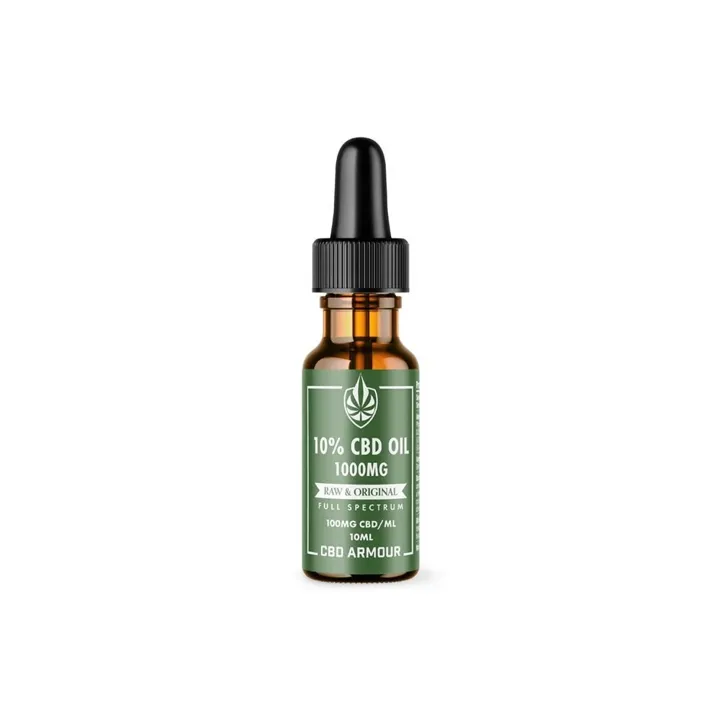
No. 10·01CBD Armour
CBD Armour Raw & Original oil, 1000mg, 10ml
10ml · 1,000mg CBD in all · about 5mg per drop
£39.974.0p per mg
Buy at CBD ArmourGummies and capsules raise a further question: is the certificate for the extract that went into the product, or for the finished sweet or capsule? Both exist, and they answer different questions. If a page does not say which, ask. For the exempt product rule the unit is the container, and a certificate for a raw ingredient does not tell you what is in a finished tub.
We have not read or recorded certificates of analysis for the products in this catalogue. The cards show the spectrum word the shop's page uses, the mg, the price and the FSA entry. If a shop publishes batch results, read them yourself, in the order above.
What this catalogue's labels say
Of the 34 oils, gummies and capsules here, 22 carry a spectrum word on the shop's page and 12 carry none. Skincare is not in the count, because we have not recorded a spectrum word for it and the FSA list does not cover cosmetics.
| Format | Products | Labelled full spectrum | Labelled broad spectrum | No spectrum word on the shop page |
|---|---|---|---|---|
| Oils | 11 | 10 | 1 | 0 |
| Gummies | 19 | 0 | 9 | 10 |
| Capsules | 4 | 2 | 0 | 2 |
| Skincare | 12 | not recorded | not recorded | not recorded |
Does the word explain the price? On these 34 products I cannot find that it does. The full spectrum oils run from 1.4p to 7.5p per mg, and the one broad spectrum oil sits in the middle at 5.2p. The gummies, all Supreme's broad spectrum, run from 2.5p to 6.2p per mg, and the ones with no word run from 3.8p to 7.0p. The spread inside each group is wider than the gap between the groups, so the word is not what you are paying for.
Two points. First, the oils lean full spectrum: ten of 11. The one broad spectrum oil is Herbal Health's. Second, the gummies are the opposite: all nine that carry a word are Supreme's, and all nine say broad spectrum. The other ten gummies, from Dr Watson, CBD Guru and Herbal Health, say nothing either way. The same is true of CBD Guru's and Herbal Health's capsules. Silence is not a flaw in the product. It is only a fact about what the page tells you.
The catalogue lists no isolate. We keep out isolate powders, which are outside the scope of this site, and none of the 34 products is labelled that way.
The FSA entries give a different picture from the shop pages. Only Supreme's 14 products carry the spectrum word in the name of the FSA entry itself: its oils say Full Spectrum CBD, its capsules say Full Spectrum, and its gummies say Broad Spectrum CBD. The other eight products that have a word on the shop page, from H Drop, CBD Armour and Herbal Health, do not have it in the entry's name. The entries give the name, the supplier, the size and a status. They do not carry a spectrum field, and they do not tell you what is in the extract.
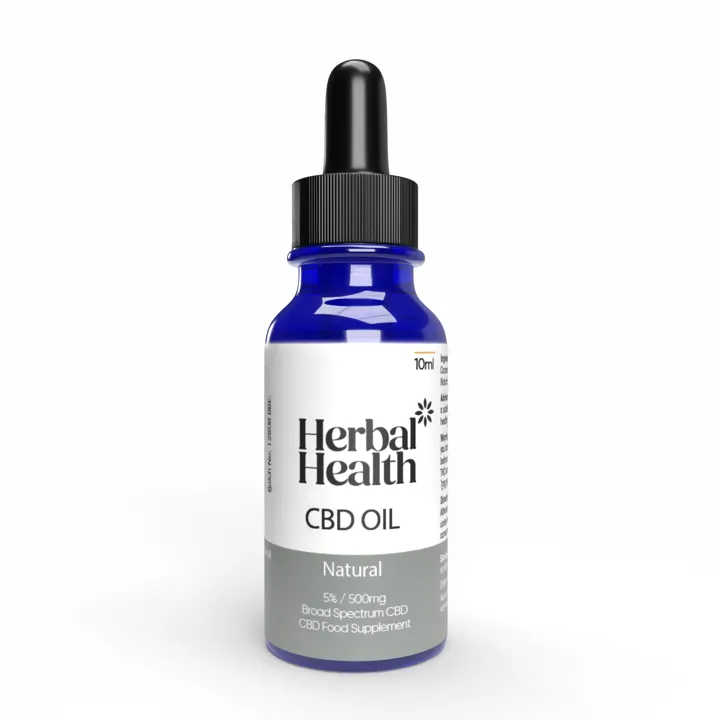
No. 10·07Herbal Health
Herbal Health 5% oil, 500mg, 10ml
10ml · 500mg CBD in all · about 2mg per drop
£25.995.2p per mg
Buy at Herbal HealthWhere isolate fits
Isolate is the one word of the three with a clear place in the official texts. The Home Office factsheet says CBD as an isolated substance, in pure form, is not controlled under the 1971 Act. The FSA's business guidance says that there are currently no CBD extracts or isolates authorised as novel foods. That sentence covers all three words on this page: an extract can be full spectrum or broad spectrum, and none of them is authorised.
The FSA's September 2026 board paper concerns three applications, RP 7 (synthetic CBD), RP 350 and RP 427 (both isolates), for high-purity CBD of 98% or more, at no more than 10 mg a day for adults. The FSA recommended to ministers that all three be authorised, and when we last looked, on 18 November 2026, no ministerial decision had been published. I leave what that means for other labels to the FSA. This guide reads labels, it does not forecast decisions. The FSA's open data list does hold isolate entries, such as isolate by the gram, which are outside this catalogue.
What Validated says about the word
Nothing. Validated means that the application holds the information the law requires and has moved on to risk assessment. It is not an authorisation, it is not an endorsement of the extract, and it does not say whether a product is full spectrum, broad spectrum or isolate. The products here are listed as Validated on the FSA public list, with a cbdid number on each card. The list covers England and Wales only and was last updated on 13 April 2026.
One more reminder for the edible formats. The FSA's consumer advice is that healthy adults limit CBD from food to 10 mg a day, about four or five drops of a 5% oil. It advises against CBD for under 18s, people taking medication, and anyone pregnant, breastfeeding or trying to conceive. A spectrum word does not change any of that.
Questions to put to a shop
- Is there a certificate of analysis for the batch I will receive, and can I see it before I buy?
- Which lab wrote it, and is it accredited to ISO/IEC 17025?
- What is the THC figure for the whole bottle, and what is the lab's reporting limit?
- Which cbdid on the FSA list is this exact product, with this name and this size?
- What does the label mean by full spectrum, broad spectrum or isolate, if the page does not say?
A shop that answers all five has given you more than any spectrum word. A shop that cannot has told you something too.
Questions people ask
What is the difference between full spectrum, broad spectrum and isolate CBD?
They are the maker's words, and none is defined in the Home Office, FSA or legislation texts we read. Generally, full spectrum keeps other plant compounds including a trace of THC, broad spectrum keeps some with THC removed or reduced, and isolate is CBD alone. Each sends you to a certificate of analysis to check, because the word alone proves nothing.
Is full spectrum CBD legal in the UK?
That is a legal question, and this is not legal advice. The Home Office says CBD products are highly likely to contain controlled cannabinoids such as THC, and that a product is exempt only if it meets the conditions in regulation 2 of the Misuse of Drugs Regulations 2001, including no more than 1 mg of the controlled drug per component part, such as a bottle of oil. A label word does not settle it.
Does broad spectrum mean zero THC?
Not by any definition we found. Makers use broad spectrum for an extract with THC removed or reduced, and reduced is not none. The exempt product rule allows up to 1 mg in a container, so the question is what the certificate of analysis reports for the whole bottle, and what the lab's reporting limit is. Ask the shop for the batch certificate.
What does the 1 mg THC rule mean for a 10ml bottle?
The regulation sets 1 mg of the controlled drug per component part, and the Home Office factsheet gives a bottle of oil as the container. For a 10 ml bottle that is 0.1 mg per ml in total, and for a 30 ml bottle a third of that per ml. These sums are our arithmetic from the official figure. Compare them with the certificate.
How do I read a CBD certificate of analysis?
Check the lab name and its ISO/IEC 17025 accreditation, that the batch number matches your bottle, and the date. Then convert the CBD and THC results to the whole bottle by multiplying by the ml. Read the lab's reporting limit too: a result of not detected with a limit of 0.5 mg per ml could hide up to 5 mg in 10 ml.
Does the FSA list say whether a product is full spectrum or isolate?
No. Each entry has a product name, supplier, size, application number and status, and no spectrum field. Where a spectrum word appears, it is because the maker put it in the product name, as Supreme does in its entries. The list does hold isolate products, but a word in a name is the applicant's, not a check by the FSA.
Which products in this catalogue are full spectrum?
On the shop pages, ten of the 11 oils and two of the four capsules are labelled full spectrum. One oil, Herbal Health's 5%, and the nine Supreme gummies are labelled broad spectrum. Ten gummies and two capsules carry no word, and none of the 34 is labelled isolate. We have not recorded certificates, so read any a shop publishes.
Is CBD isolate authorised as a food in the UK?
Not yet. The FSA's guidance says there are currently no CBD extracts or isolates authorised as novel foods. In September 2026 the FSA recommended to ministers that three high-purity CBD applications, including two isolates, be authorised, and no ministerial decision had been published when we last looked on 18 November 2026. Products on the FSA list are tolerated pending a decision, not authorised.
Where the facts come from
- Home Office, drug licensing factsheet: cannabis, CBD and other cannabinoids
- Misuse of Drugs Regulations 2001, regulation 2 (exempt products)
- FSA, Cannabidiol (CBD) guidance for businesses
- FSA, Cannabidiol (CBD) consumer advice
- FSA public list of CBD products
- FSA CBD products list: guidance notes on the statuses and fields
- FSA CBD products register: open data listing (CSV)
- FSA board paper, September 2026: recommendations to ministers on first CBD authorisations